
 86 13392660243
 hope17@cnhopestar.com
 whatsapp
Government Tablet Supply in Brazil: A 4-Step Compliance Path Before Volume Procurement
 2026-09-18
 cnhopestar
Government tablet procurement is different from a standard commercial tablet order. For suppliers entering a public-sector project in Brazil, the first challenge is often not production capacity, but whether the proposed device, configuration and supporting documentation can satisfy the project's applicable market and procurement requirements.
This creates a particular challenge for suppliers. A tablet may be technically suitable for the intended application, yet the project can still be delayed if the applicable Brazilian compliance requirements have not been identified, the supplied configuration is not clearly defined, or the engineering sample differs from the product planned for volume production.
For procurement teams, the solution is not to treat certification as a standalone checkbox. The compliance question needs to be connected to the actual product configuration, engineering sample and subsequent production plan.
A practical four-step path is:
Define the configuration → identify applicable requirements → lock the production baseline → build long-term supply controls.
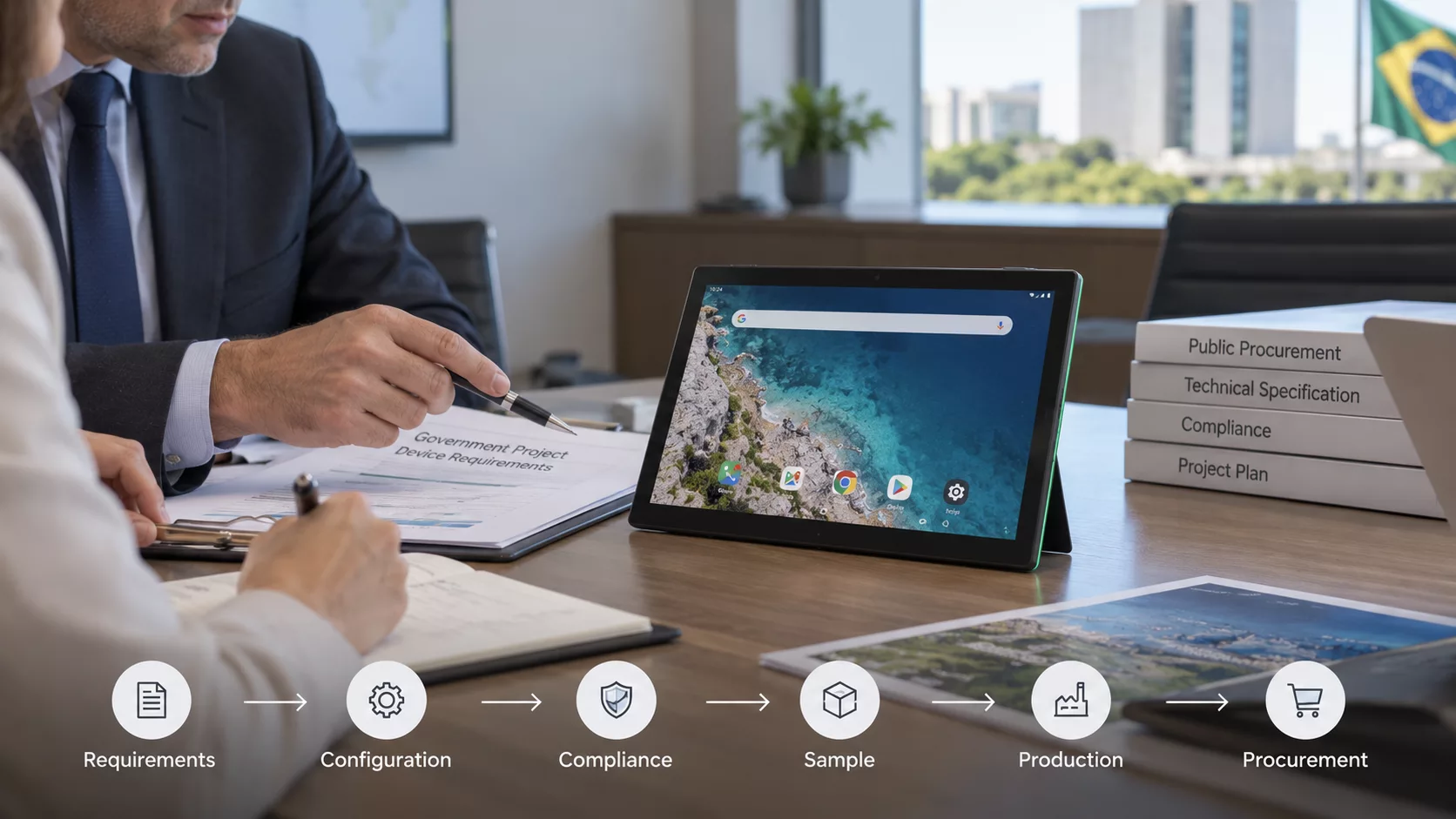
This gives both sides a clearer route from an initial government project specification to sample evaluation and, ultimately, controlled volume procurement.
Start With the Tablet Configuration, Not the Certification Name
The first question should not be “Is this tablet INMETRO certified?”
The better question is:
What exactly will be supplied to the Brazilian project?
A commercial Android tablet can have very different configurations depending on the project. Wi-Fi and Bluetooth modules, cellular connectivity, battery configuration, charger, operating system, memory, storage, enclosure, and even customized firmware can affect the technical assessment.
For a government project, the supplier should therefore provide a configuration sheet covering the actual production version.
|
Configuration Item |
What Procurement Should Confirm |
|
Display & size |
Screen size, resolution and touch technology |
|
Processor & memory |
CPU, RAM and storage configuration |
|
Wireless |
Wi-Fi, Bluetooth and optional cellular connectivity |
|
Power |
Battery, charger and power adapter |
|
OS |
Android version and required customization |
|
Mechanical |
Housing, ports and mounting requirements |
|
Software |
Pre-installed applications, restrictions and UI requirements |
|
Customization |
Logo, firmware, accessories and packaging |
This step is also where buyers can narrow down the appropriate product family.
For example, a standard Android tablet may be sufficient for general government field operations, while a larger-screen model may be more appropriate for digital forms, public-service applications or fixed workstation-style deployments.
If your project already has requirements for screen size, Android version, connectivity, RAM/storage or accessories, sharing those specifications with the supplier first can make the product-selection process much more efficient.
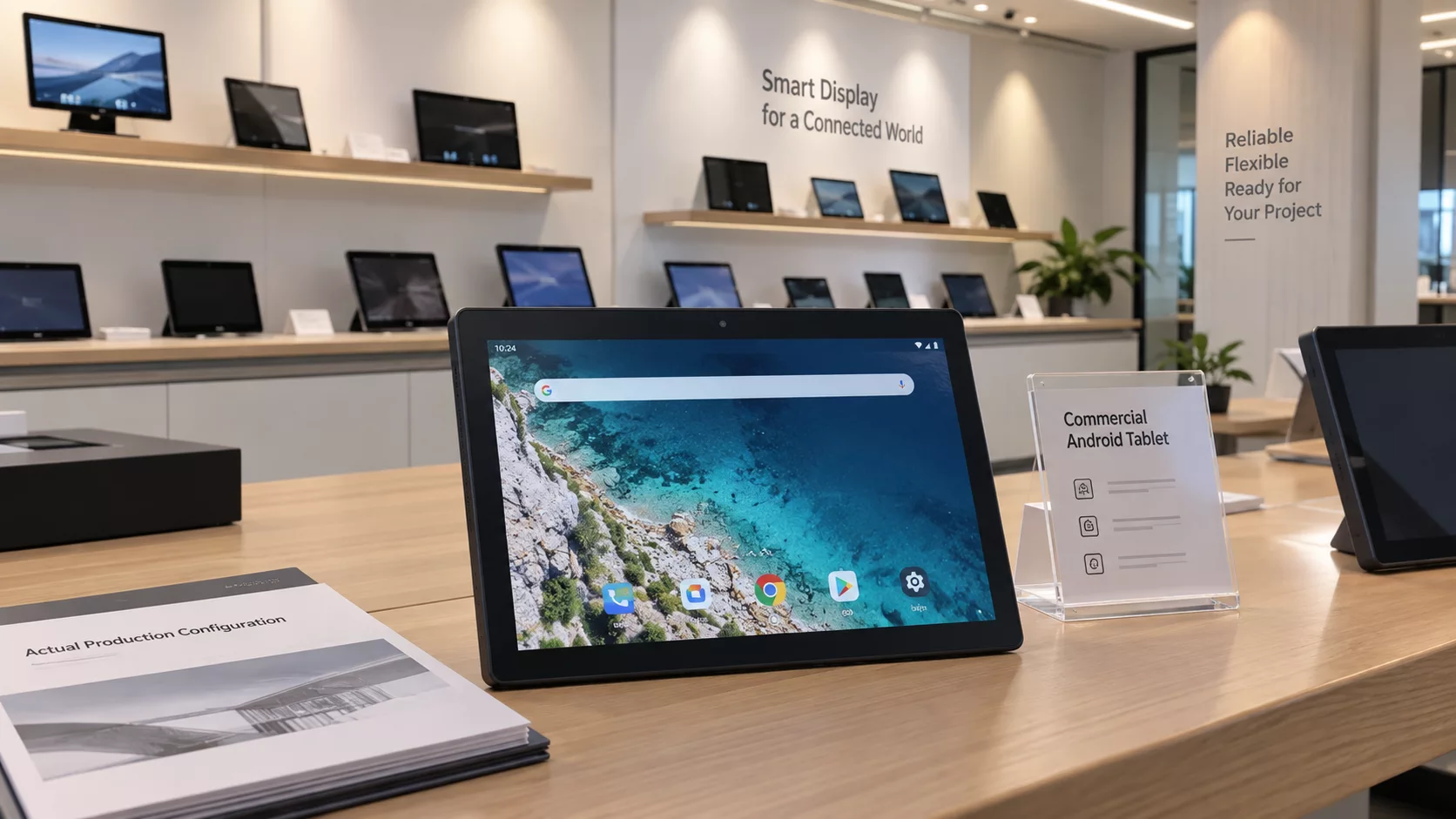
Our Android tablet portfolio can be evaluated according to the required deployment configuration, with standard models available as a starting point for project selection and OEM/ODM customization where the project requires changes to hardware, appearance or software.
Determine Which Brazilian Requirements Actually Apply
Once the configuration is defined, the next step is to determine which Brazilian requirements apply to that specific configuration.
This is where buyers should avoid treating “Brazil certification” as a single requirement.
For telecommunications products, Anatel operates a certification and homologation framework. Anatel states that homologation is required for the legal commercialization and use of applicable telecommunications products in Brazil. Its certification process covers products according to their applicable technical requirements and product categories.
As of September 8, 2026, Anatel's certification and homologation procedures are being handled through its new Certifica platform, replacing the previous SCH system for new applications.
INMETRO is different. It regulates specific products and services through technical regulations and conformity assessment programs. Whether an INMETRO requirement applies therefore needs to be checked against the exact product and applicable regulation rather than assumed simply because the product is a tablet.
This distinction matters because a project may involve several compliance questions at the same time:
Does the tablet configuration fall within an applicable Anatel framework?
Does any supplied accessory fall under an applicable INMETRO program?
Does the government tender specify additional documentation or testing?
Who will be responsible for the certification or registration process?
Does the evaluated configuration need to remain unchanged through production?
The practical output of this stage should be a Brazil compliance checklist linked to the exact product configuration.
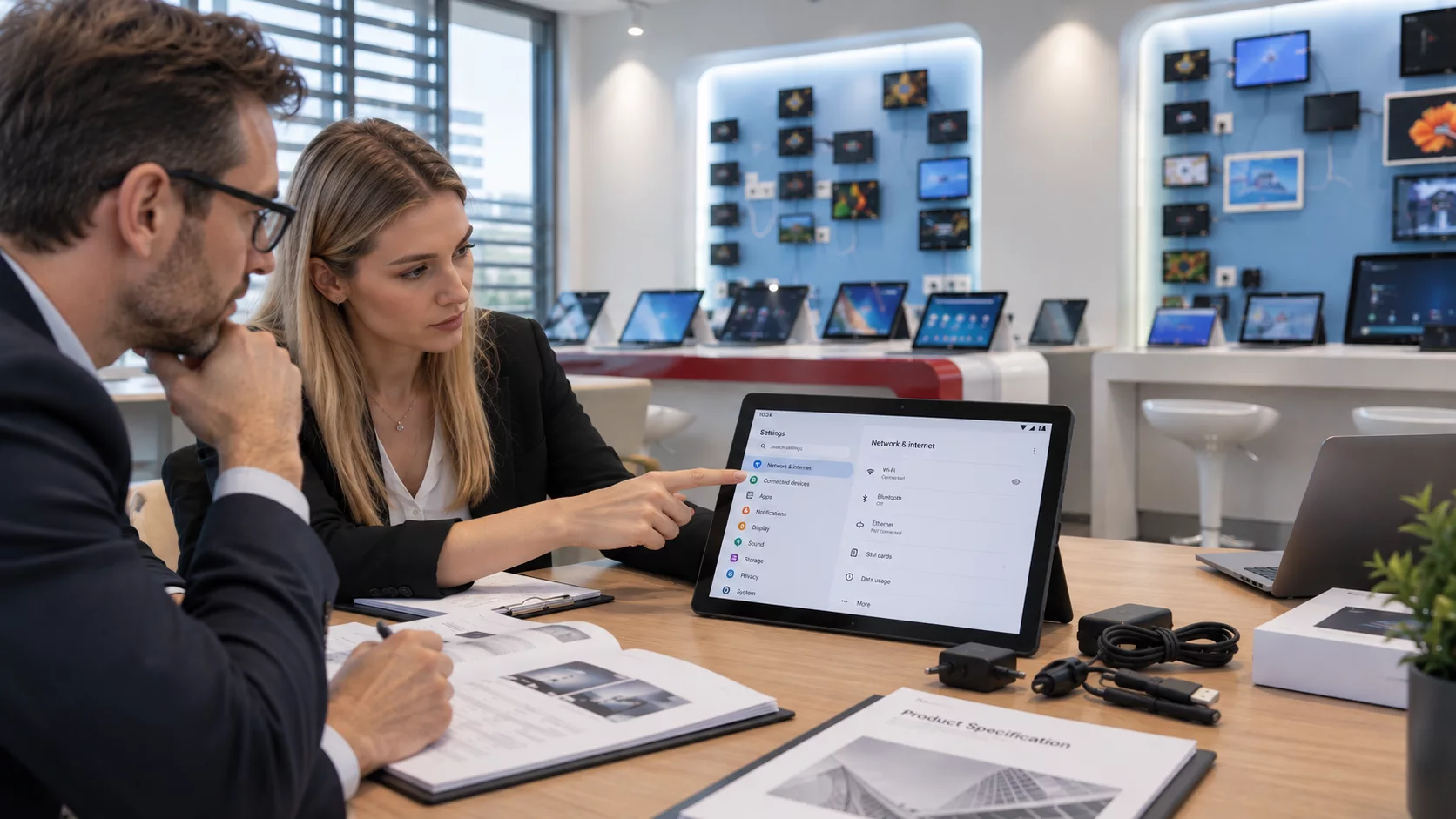
If your procurement team is still at the project evaluation stage, you can send us the target configuration, intended application and required market documents. We can then identify which technical details need to be confirmed before moving into sample evaluation.
Make Sure the Engineering Sample Becomes the Production Product
For government tablet projects, approving an engineering sample is only the beginning. The greater challenge is keeping the approved configuration consistent when the project moves into volume production.
Our OEM/ODM process is built around this transition. Once a project configuration is defined, the engineering sample establishes the hardware and software baseline for subsequent production. Key specifications such as the processor, memory, wireless module, battery, charger, operating system, enclosure and ports can be confirmed against the project requirements before the sample is approved.
The production configuration is then managed against the confirmed product baseline. This helps reduce the risk of a component being changed simply because of availability, cost or manufacturing considerations after the sample has been accepted. When a critical component needs to change, the replacement can be treated as an engineering change and reviewed against the original project configuration before it is introduced into production.
The practical workflow is:
Project specification → Engineering sample → Configuration confirmation → BOM control → Mass production
This approach is particularly relevant when a government project requires customized hardware, software, branding or accessories. Instead of treating the sample as a one-time demonstration unit, the confirmed configuration can serve as the reference for the subsequent production order.
For the buyer, this creates a more consistent path from technical approval to batch delivery. The tablet received during volume procurement is built around the same defined product configuration that was evaluated during the project stage, reducing the risk of discrepancies between the approved sample and the final production units.
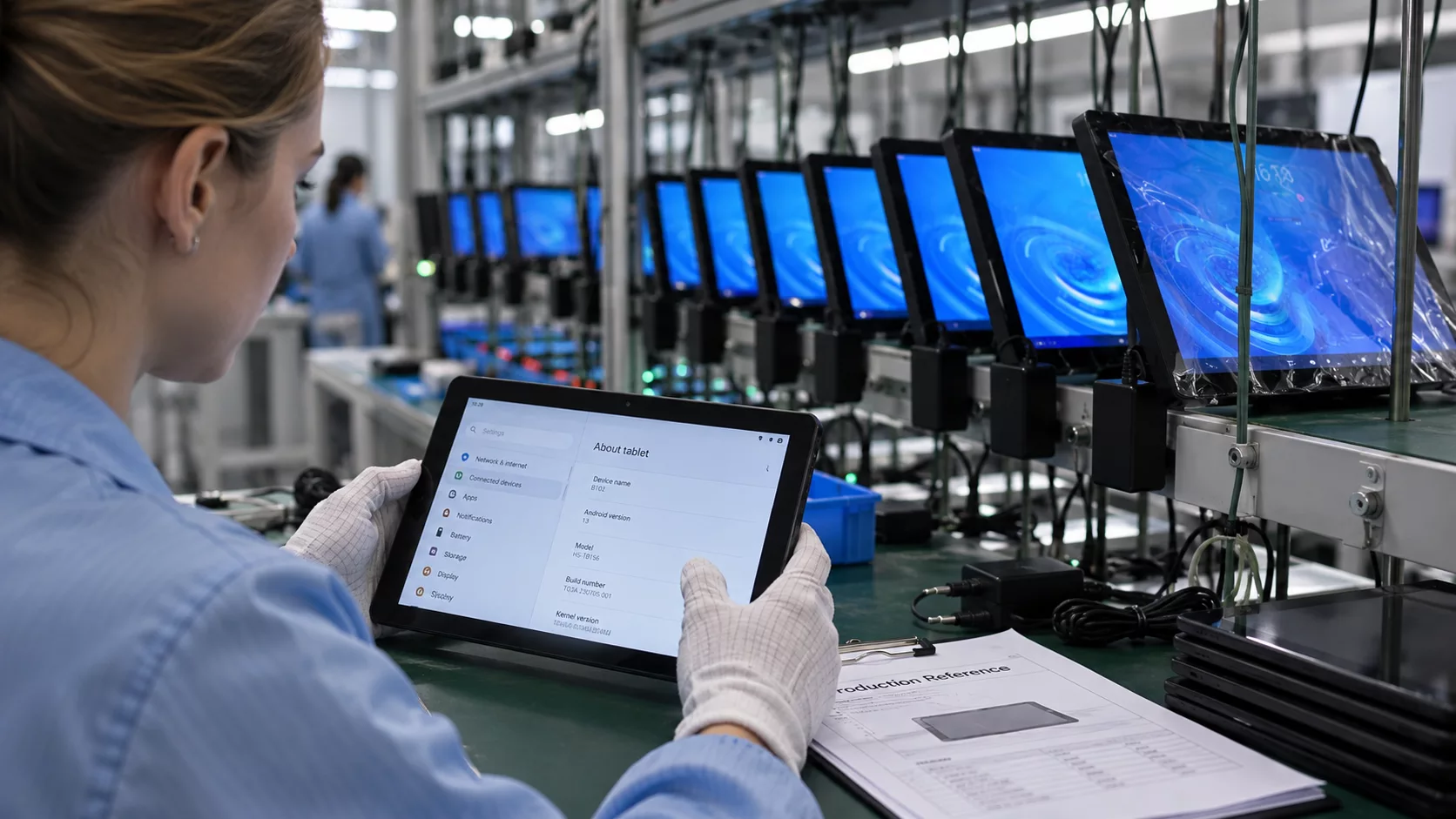
This OEM/ODM capability also allows projects to start from an established Android tablet platform rather than developing every component from scratch. Depending on the application, the platform can be adapted for different screen sizes, memory and storage configurations, connectivity options, software requirements, accessories and external design while keeping the approved configuration under production control.
Choose the Product Family Around the Deployment
Government projects do not all require the same type of Android tablet. The right product family depends on how the device will actually be deployed.
For field-service teams, mobile inspections and outdoor data collection, a rugged Android tablet can provide a more suitable platform where the device needs to withstand frequent handling and demanding working environments. For public-service counters, education programs and digital form applications, larger-screen Android tablets can provide more working space for applications and user interaction. For fixed information points, kiosks and integrated equipment, Android tablets with appropriate mounting, peripheral connectivity or customized interfaces can be considered as part of the overall installation.
This deployment-based selection is more useful than starting with a generic requirement such as “Android tablet supplier.”
Our portfolio includes different Android tablet form factors and configurations that can be matched to these application requirements, including rugged Android tablets for field and industrial deployments, large-screen Android tablets for public-service and information applications, and customizable Android tablet platforms for OEM/ODM projects. These product categories can serve as starting points before the project specification is finalized.
For example, a buyer planning a mobile government service project can start by reviewing our Rugged Android Tablets category, while a project requiring a larger interactive display can evaluate our Large-Screen Android Tablets. Where the project requires customized hardware, software, branding or accessories, our OEM/ODM Android Tablet Solutions can provide a starting point for technical discussion.
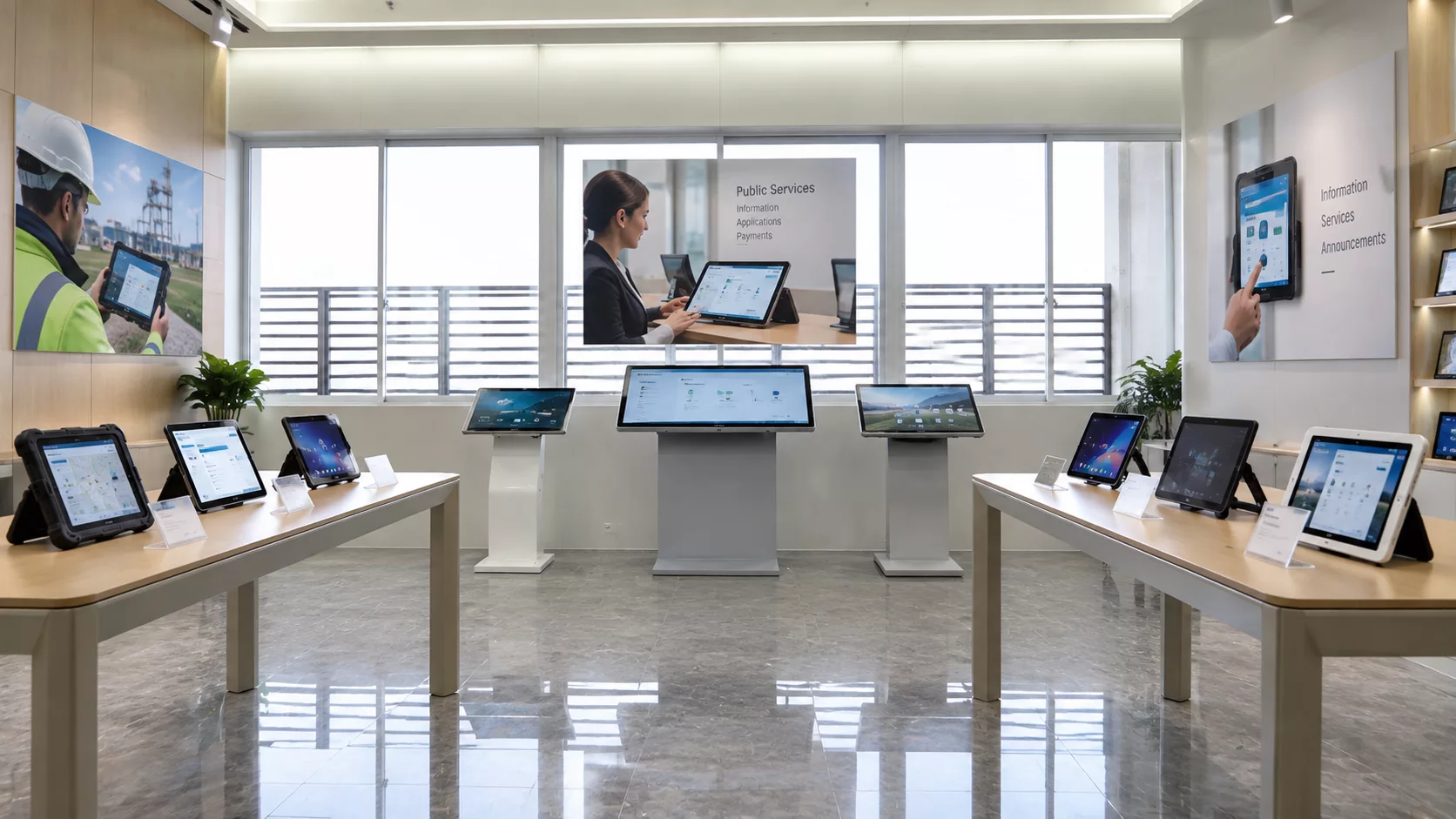
The purpose of this approach is not to force every project into one standard model. It allows the buyer to begin with a product platform that already matches the deployment scenario and then determine which configuration changes are actually necessary.
For projects that require standard Android tablets, customized configurations or OEM/ODM cooperation, contact our team with your project specifications to discuss the suitable tablet series, sample configuration and next steps for Brazil market evaluation.
 Replacing an Existing POS System with a Windows POS Terminal: A UK Retail Procurement Guide