 86 13392660243
 hope17@cnhopestar.com
 whatsapp
One-Stop Gaming Monitor OEM: From Product Selection to Branded Production
 2026-10-05
 cnhopestar
A gaming monitor brand is rarely built around a single specification. Once you move from reselling existing products to building your own lineup, the real challenge is coordinating the panel, housing, branding, packaging, quality control, and production into one workable product system.
Current gaming monitor research points in the same direction: competition is becoming increasingly segmented by refresh rate, resolution, panel technology, screen size, and price tier. High-refresh products continue to expand, while OLED is moving further into mainstream premium gaming displays. At the same time, conventional 165Hz products are facing stronger price competition.
For a distributor becoming a brand owner, this changes the OEM question. You do not simply need a factory that can manufacture a monitor. You need a gaming monitor OEM process that allows different product configurations to be developed under one supply chain.
That is where our approach starts.
Build the Product Line Before Building the Brand
The first decision is not the logo. It is the monitor platform behind the logo.
For a new gaming monitor brand, we usually look at the product lineup as a combination of market positioning and technical configuration. A mainstream model can create volume, while higher-refresh or higher-resolution models give the brand room to move into more specialized segments.
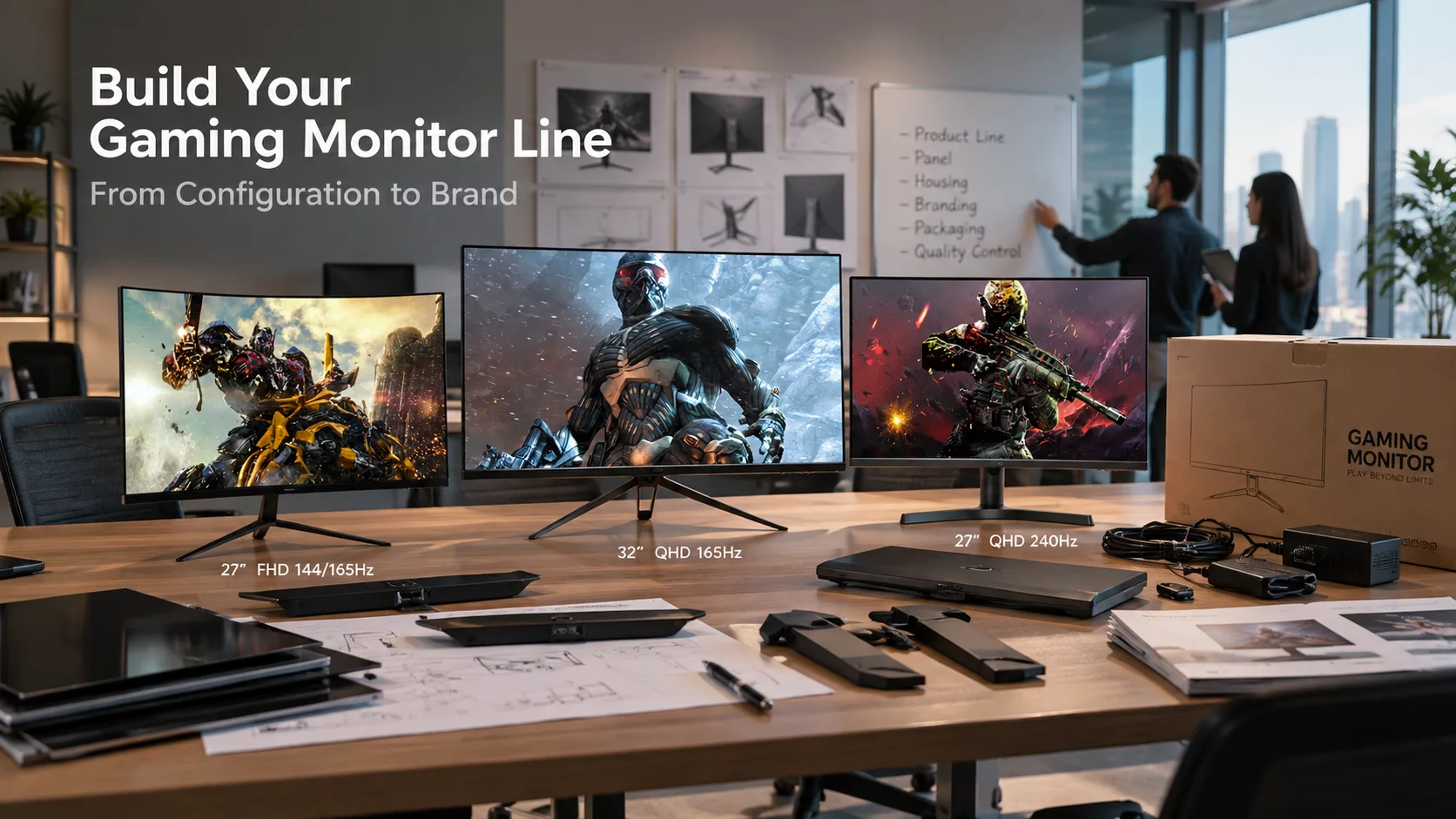
For example, our 27-inch FHD 144/165Hz gaming monitor is a practical starting point for a mainstream gaming lineup. The 27-inch format gives you a familiar gaming-screen size, while FHD and 144/165Hz keep the specification accessible for price-sensitive channels.
If you want to move the lineup toward QHD, our 32-inch QHD 165Hz gaming monitor creates a different product position. The larger 32-inch screen and 2560×1440 resolution make it suitable for a more immersive desktop gaming experience without immediately moving into the cost structure of premium OLED products.
For a higher-performance product, our 27-inch QHD 240Hz gaming monitor gives the lineup a clear high-refresh option. QHD combined with 240Hz is particularly useful when you want a product that sits above the mainstream 144/165Hz segment while remaining different from an OLED flagship.
This kind of structure is more useful than launching several monitors that differ only slightly. A three-product lineup can already establish different positions: accessible FHD, mainstream QHD, and high-refresh QHD.
Panel Selection Should Match the Product Position
Once the product structure is clear, panel selection becomes much easier.
A gaming monitor OEM bundle should not treat the panel as an isolated component. Resolution, refresh rate, response time, screen size, panel technology, and target price all affect the final product positioning.
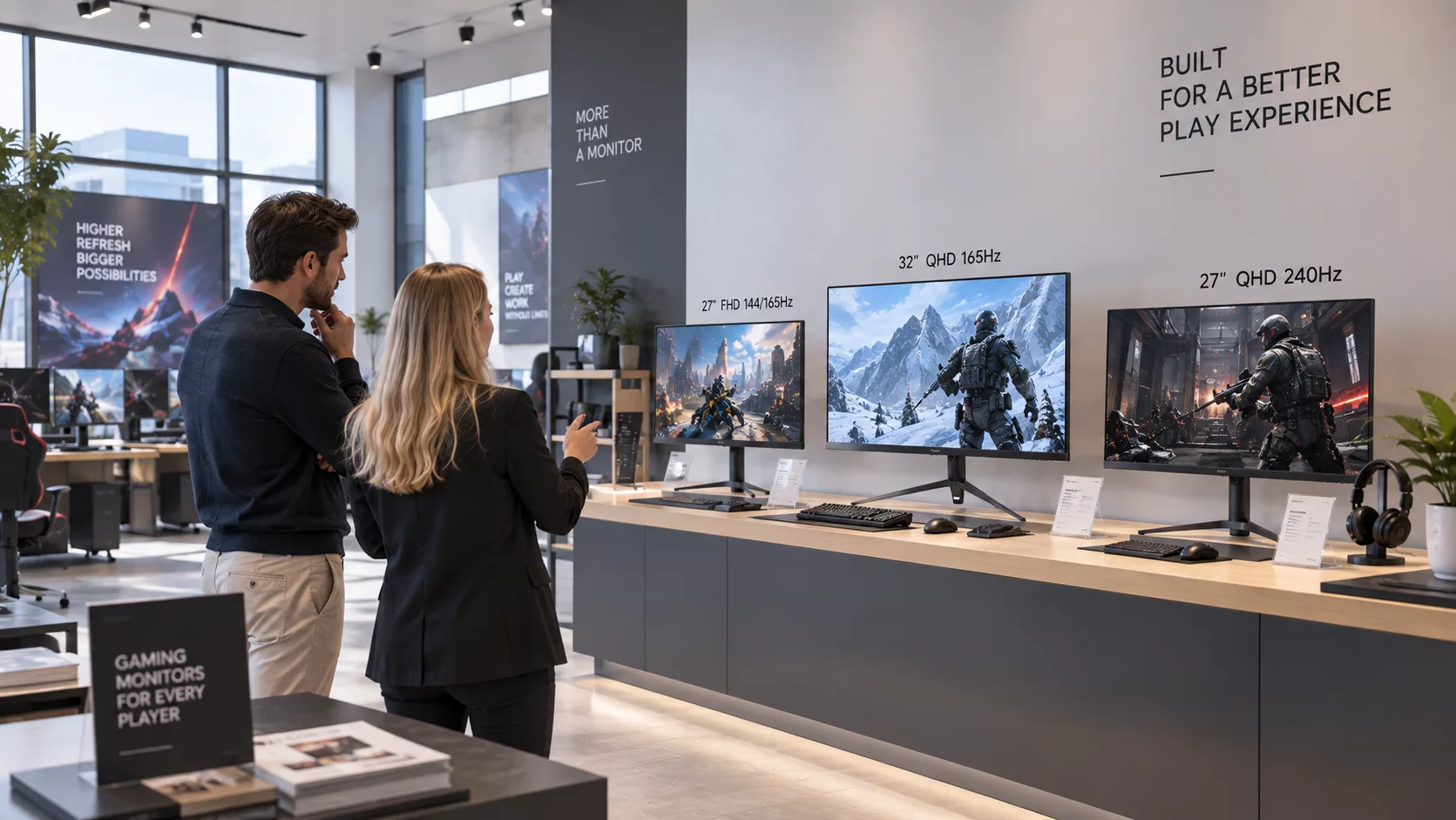
For example, 27-inch FHD at 144/165Hz can work well when the priority is competitive pricing and broad channel compatibility. A 32-inch QHD 165Hz monitor moves toward a larger-screen gaming experience. A 27-inch QHD 240Hz product addresses users looking for a higher-refresh gaming specification.
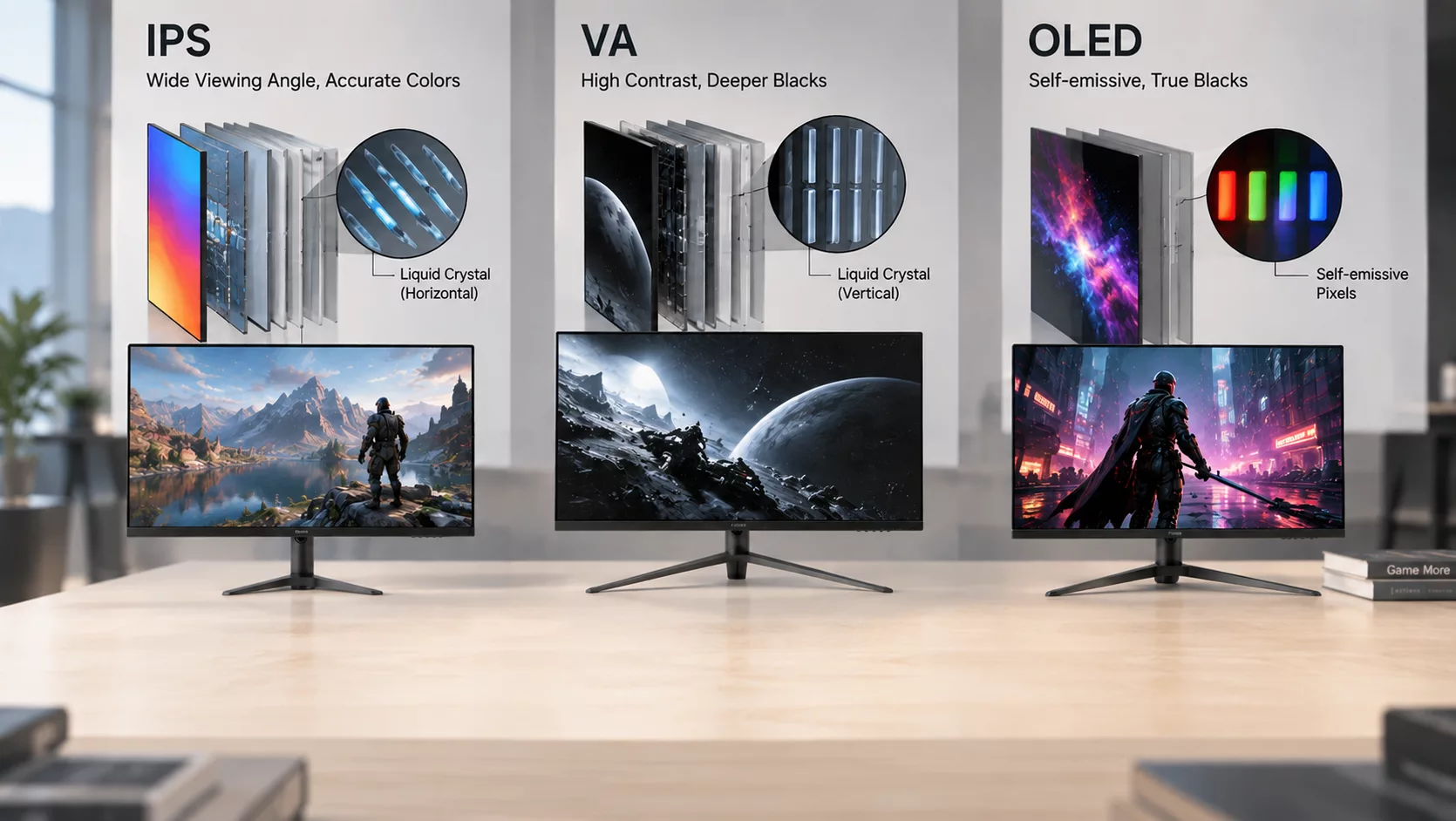
The same logic applies when considering IPS, VA, OLED, or other panel technologies. The question is not simply which technology is technically superior. The more practical question is whether the panel configuration supports the price, positioning, channel, and expected sales volume of the product.
This is why a one-stop monitor manufacturing process matters. Panel decisions need to connect with housing dimensions, internal structure, power requirements, thermal considerations, firmware, packaging, and final quality inspection.
Instead of treating every component as a separate purchasing decision, we can develop the monitor around the intended product configuration.
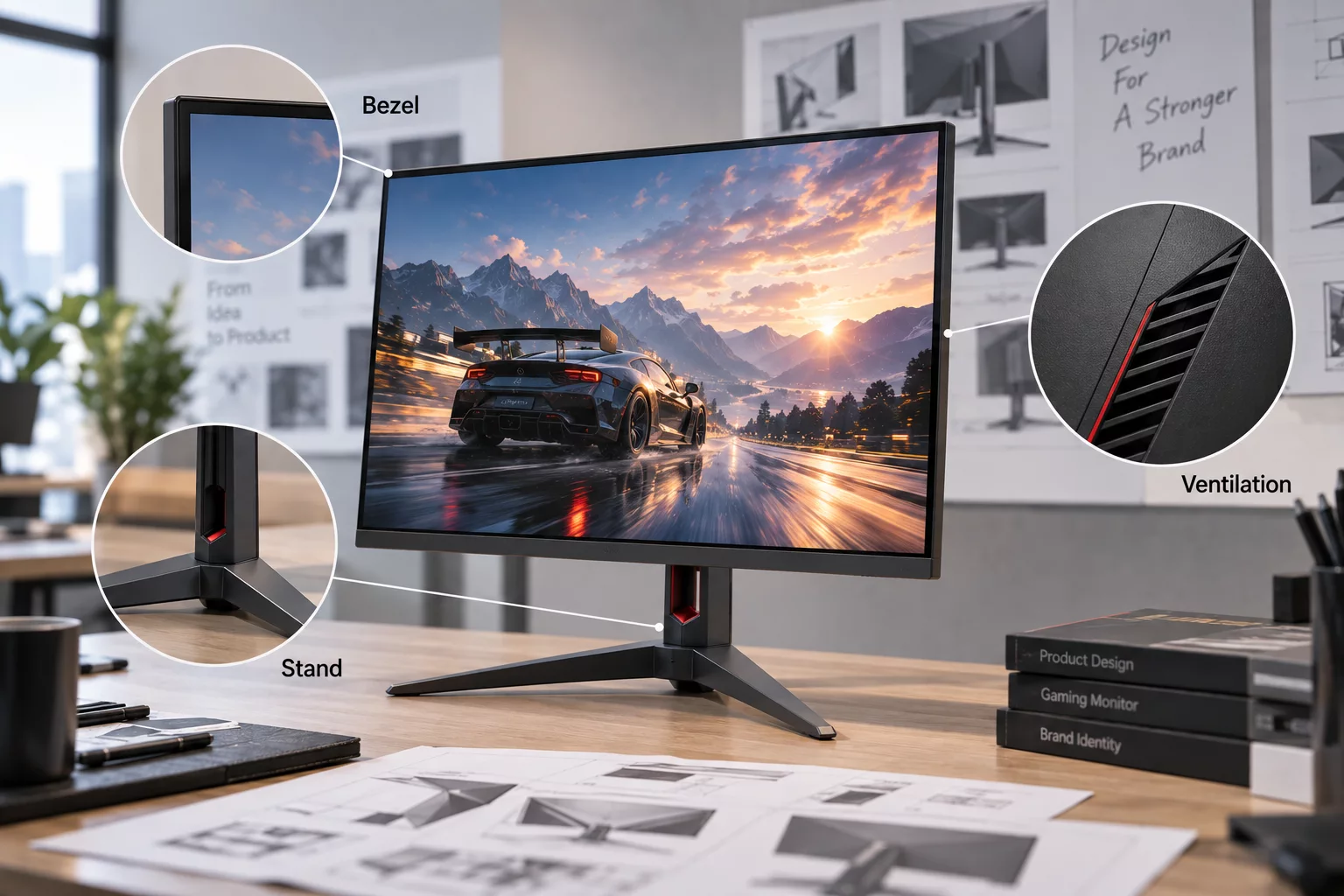
Housing Design Turns a Generic Monitor Into Your Product
A panel specification alone does not create a brand identity.
Two monitors can use similar display specifications but look completely different because of the housing, stand, bezel, rear cover, ventilation structure, and overall industrial design. For a brand owner, this is where OEM becomes more meaningful than simply purchasing an existing SKU.
Our gaming monitor OEM manufacturer service supports customized appearance development and customized mould solutions. This gives you room to move from an existing monitor platform toward a product designed around your brand requirements.
The level of customization depends on the project. Some projects can begin from an existing housing structure and focus on branding and packaging. Others require a more differentiated appearance and mould development.
This approach also helps control development complexity. You do not necessarily need to create an entirely new monitor from zero. The practical route can be to establish a proven technical platform first and then determine where customization creates the most commercial value.
For a new brand, that might mean a customized rear cover and stand. For a more established gaming brand, it may mean a more distinctive housing design that becomes part of the visual identity across several screen sizes.
The objective is to make the product recognizable without turning every SKU into an independent engineering project.
Logo and Packaging Complete the OEM Bundle
Brand customization should continue beyond the monitor itself.
We support logo customization for the product and packaging, allowing the same brand identity to carry through the monitor, color box, and shipping materials.
Packaging is particularly important when the monitor is sold through distributors, retail channels, or direct-to-consumer websites. A technically identical product can have a very different market presentation depending on how the box, product labeling, manuals, accessories, and external branding are handled.
Our packaging customization capability allows the packaging to be developed as part of the OEM project rather than treated as a separate task after the monitor is finished.
This is also where a private label gaming monitor project becomes more than simply putting a logo on an existing product. The product appearance, brand identity, packaging, and product lineup need to tell the same story.
For example, if your flagship product is positioned around high-refresh QHD gaming, the packaging and visual identity should communicate that positioning before the customer even turns on the monitor.
One OEM Process From Configuration to QC
The value of a turnkey monitor OEM solution is ultimately about reducing coordination between different suppliers.
If the panel comes from one company, housing from another, packaging from a third supplier, and final assembly from another factory, you become responsible for coordinating specifications between all of them. A small change in one component can create problems somewhere else.
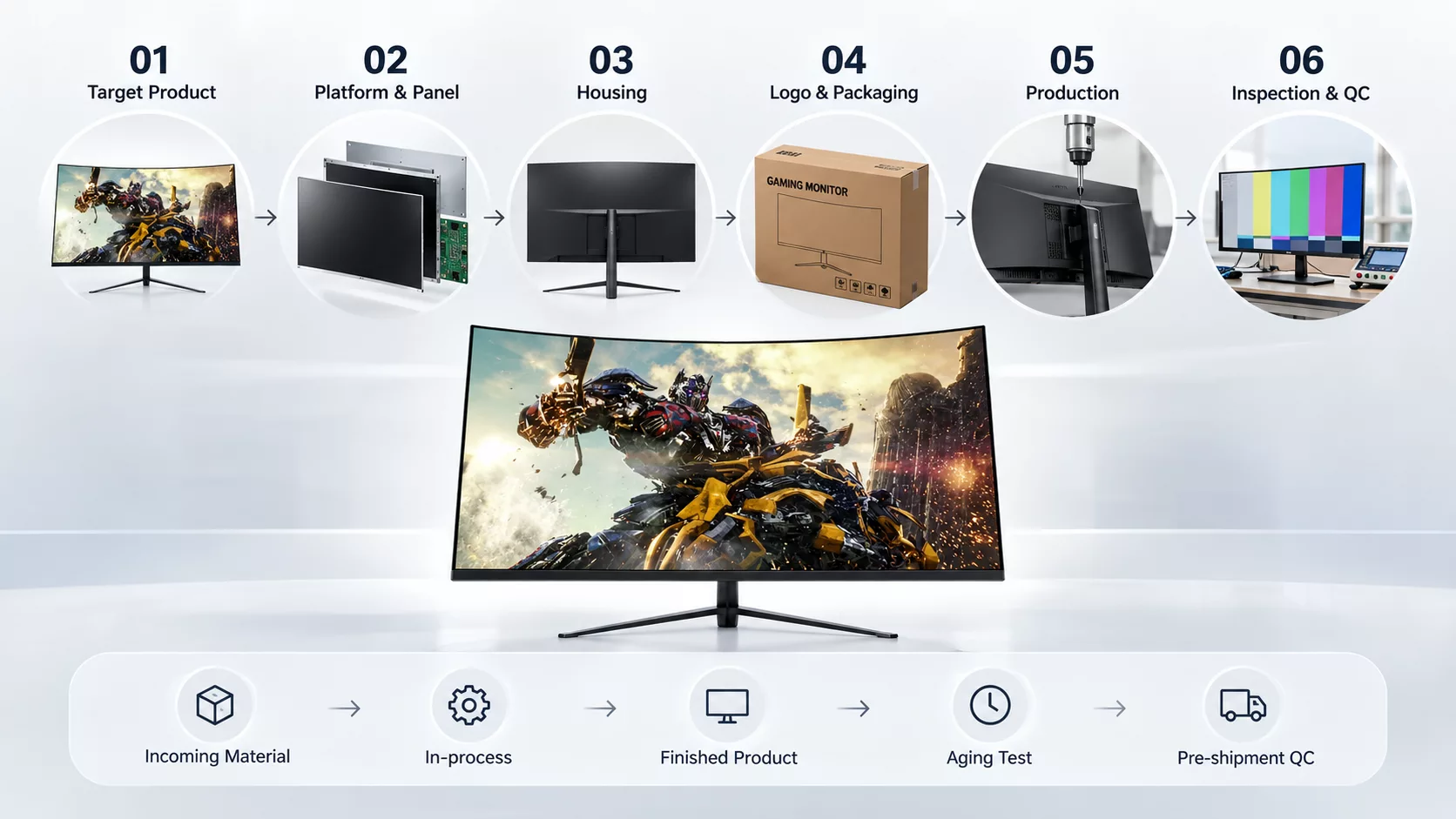
Our approach brings these stages into one production workflow:
- Define the target product and market position.
- Select the monitor platform and panel configuration.
- Confirm housing and appearance requirements.
- Develop logo and packaging customization.
- Move the approved configuration into production.
- Complete production inspection and pre-shipment QC.
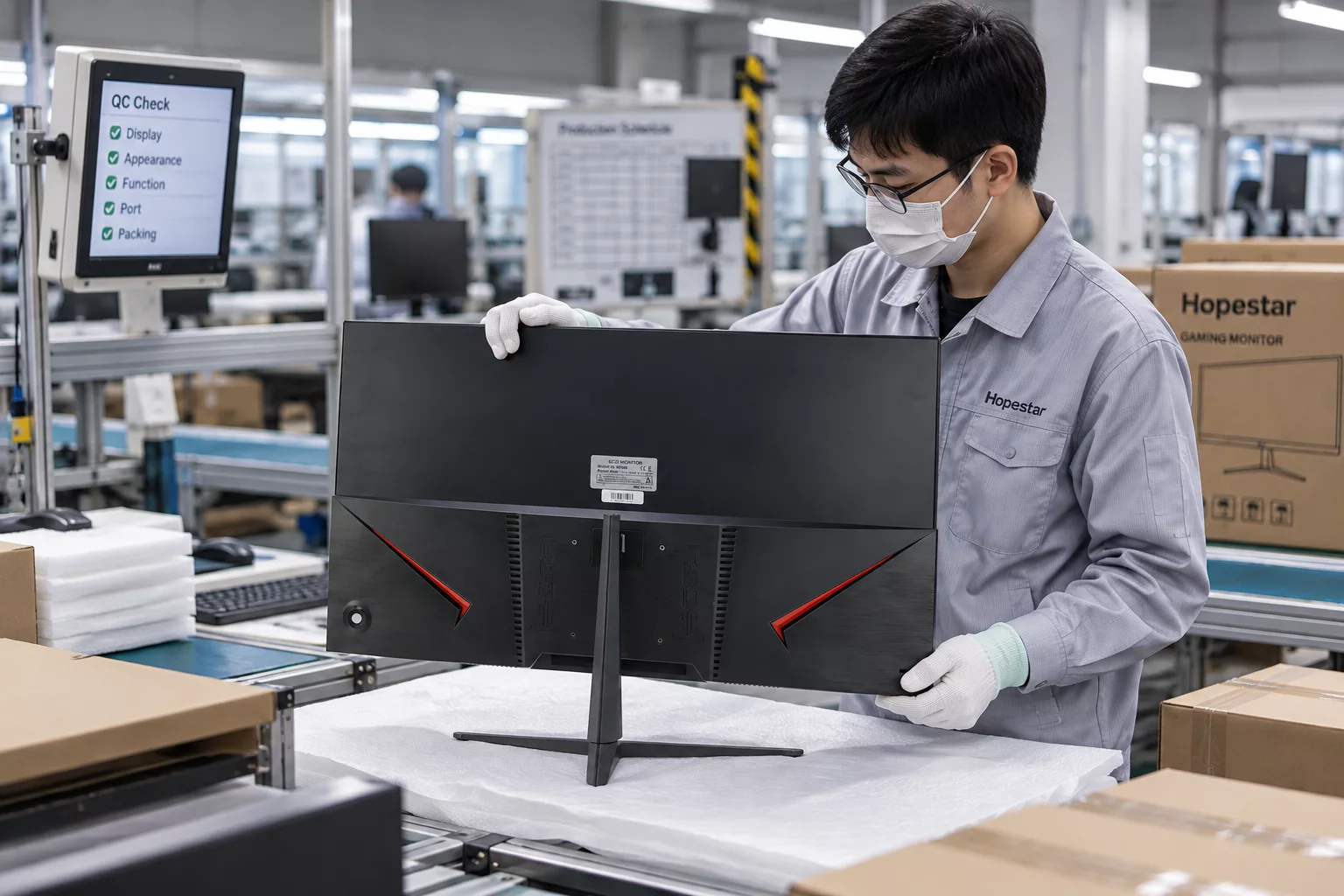
Quality control is part of this process rather than something added at the end. Our production inspection includes incoming material checks, in-process inspection, finished-product inspection, aging testing, and other reliability checks used during production.
For a gaming monitor brand, this matters because the final product is not judged only by whether the panel displays an image. Consistency across units, appearance, interfaces, power performance, packaging condition, and overall assembly quality all affect the customer experience.
This is why we position custom monitor manufacturing as a complete product-development process rather than simply a logo-printing service.
Build a Portfolio, Not Just One SKU
A common mistake when entering the gaming monitor market is trying to make one product cover every customer segment.
A more practical structure is to build a small product matrix and expand it according to actual channel demand.
You can start with a 27-inch FHD 144/165Hz gaming monitor for the mainstream segment, add a 32-inch QHD 165Hz gaming monitor for larger-screen QHD demand, and then introduce a 27-inch QHD 240Hz gaming monitor as a higher-refresh model.
From there, the same OEM relationship can support additional sizes, resolutions, refresh rates, or appearance directions as the brand develops.
Our gaming monitors product range provides the starting point for evaluating the available product platforms.
The important point is that OEM should support the evolution of your product portfolio. You should not have to change manufacturing partners every time the brand moves from a mainstream model to a more specialized gaming display.
That is also why choosing a gaming monitor manufacturer should be based on more than the specification of one product page. The more important question is whether the manufacturer can connect product configuration, customization, production, packaging, and QC into one process.
From Product Selection to Your Own Gaming Monitor Brand
A successful OEM project usually starts with a specific product decision rather than a vague request for a catalog.
If you already know the target screen size, resolution, refresh rate, price range, branding direction, or sales channel, we can use those requirements to narrow down the appropriate product platform and customization route.
If you are still comparing configurations, we can start from the existing product range and work toward a lineup that matches your intended market.
For a gaming monitor OEM manufacturer, the real value is not simply producing the monitor. It is helping you move from a product specification to a finished branded product that can actually enter your sales channel.
If you are developing a gaming monitor brand, expanding an existing display portfolio, or evaluating a private-label project, contact us with your target configuration and customization requirements. We can discuss the product platform, appearance, logo, packaging, and production path around your specific project.
 VA vs IPS vs OLED for Gaming: How OEM Buyers Should Choose the Right Panel