
 86 13392660243
 hope17@cnhopestar.com

 whatsapp
How to Estimate Landed Cost for Imported Android Tablets: From Supplier Quote to Cost per Unit
 2026-10-21
 cnhopestar
A competitive Android tablet quote does not automatically mean a lower import cost. At CnHopestar, we help buyers evaluate product specifications, customization, packaging, and order quantities so they can compare supplier quotes on a consistent basis and prepare a more realistic landed cost for electronics estimate for their Android tablet imports.
The key is to separate the costs we can quote as a manufacturer from freight, import charges, and other expenses that depend on the shipment and destination market.
1. Supplier Quote vs. Landed Cost: What Are You Actually Comparing?
When we quote an Android tablet, the price depends on the product configuration, order quantity, customization requirements, and agreed delivery terms. The quoted price is only one part of the buyer’s total cost.
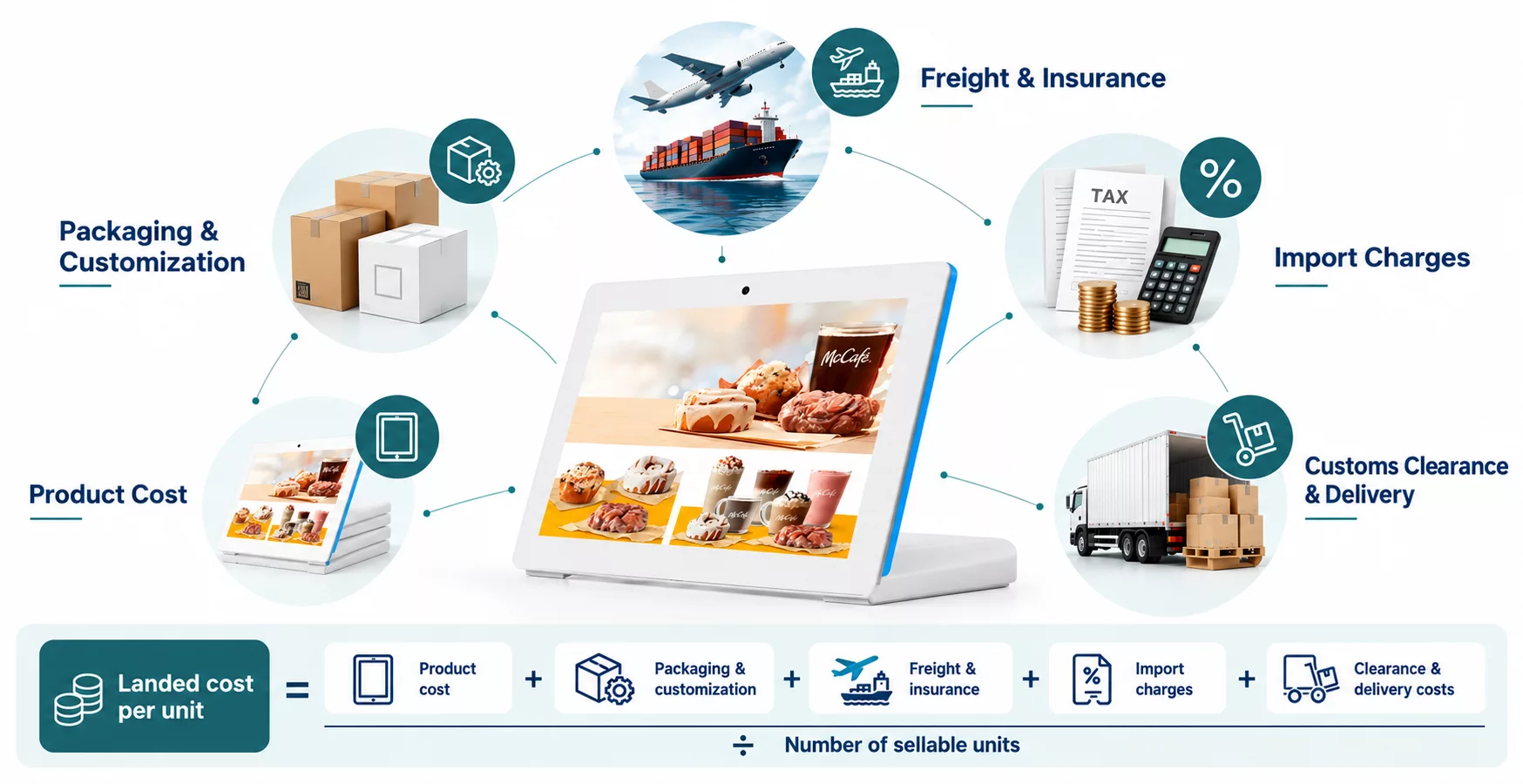
For an import purchase, the landed cost per unit can be estimated as:
Landed cost per unit = (Product cost + Packaging and customization + Freight and insurance + Import charges + Clearance and delivery costs) ÷ Number of sellable units
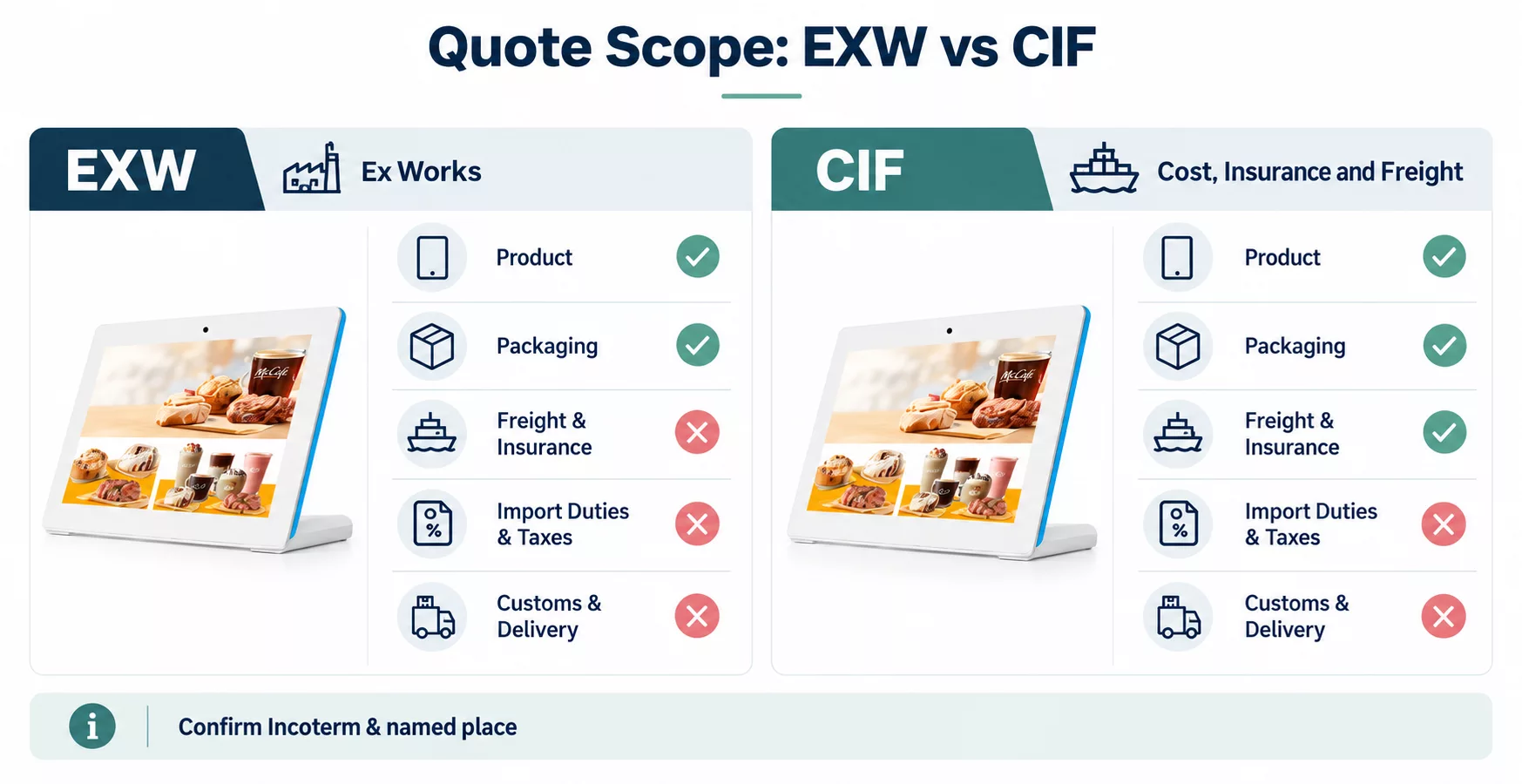
The exact cost categories depend on the agreed Incoterm and what each supplier includes in its quote. For example, an EXW quote and a CIF quote do not cover the same scope. Comparing their unit prices directly can lead to the wrong purchasing decision.
Before comparing suppliers, we recommend putting every quote into the same structure:
| Cost item | What to check |
| Product | Same screen size, hardware configuration, accessories, and quantity |
| Customization | Logo, housing, software, packaging, and any setup charges |
| Packaging | Export carton dimensions, gross weight, and packing method |
| Freight and insurance | Whether included, the destination covered, and the transport mode |
| Import costs | Applicable duties, taxes, and clearance charges |
| Delivery | Whether the quote covers delivery to the port, warehouse, or final address |
The most important distinction is between costs included in the supplier’s quote and costs the buyer must arrange or pay separately. We can provide product pricing and relevant packaging information; the buyer can then combine these figures with freight quotations and destination-specific import estimates.
A supplier offering a lower unit price may still produce a higher total cost if its quote excludes accessories, customization, freight, or other necessary items. The correct comparison is the total cost of receiving equivalent, usable products—not the headline price alone.
2. Android Tablet Import Cost in Brazil: Key Cost Factors for Buyers
In a Brazil-focused import scenario, a business buyer evaluating a 10.1-inch L-shaped desktop Android tablet for commercial applications may need to assess more than the supplier’s quoted price. Key considerations include estimated import-related charges, order quantities, and the minimum order quantity (MOQ) before the purchase decision can be made.
This is a useful example of why a product quote alone cannot answer an import-cost question. The product type and destination were known, but a reliable landed-cost estimate still required several decisions and inputs.

Step 1: Confirm the product and order scenario.
We first need to establish the required hardware configuration, accessories, power supply, and any branding or software customization. We also need to clarify whether the buyer is considering a sample, a pilot order, or a larger production order. These choices affect both the unit price and the way one-time costs are distributed.
For the Brazil inquiry, the confirmed product description was a 10.1-inch L-shaped desktop Android tablet for business applications. The final configuration, order quantity, and customization scope must be confirmed before treating a price as a comparable quotation.
Step 2: Establish what our quote covers.
Once the configuration and quantity are clear, we can prepare the corresponding Android tablet quotation and confirm the applicable MOQ and lead time. The quotation should also identify the delivery terms and clarify which packaging or customization items are included.
This prevents a buyer from comparing a basic tablet price with another supplier’s price for a more complete configuration.
Step 3: Collect the information needed for freight estimation.
For logistics planning, we can provide available packing details such as carton dimensions, gross weight, and packing quantity. The buyer or freight forwarder can use these details, together with the destination address and transport method, to estimate shipping costs.
The actual freight charge may depend on chargeable weight or volume, not simply the tablet’s physical weight. We therefore need shipment-level packaging data rather than relying on the product’s dimensions alone.
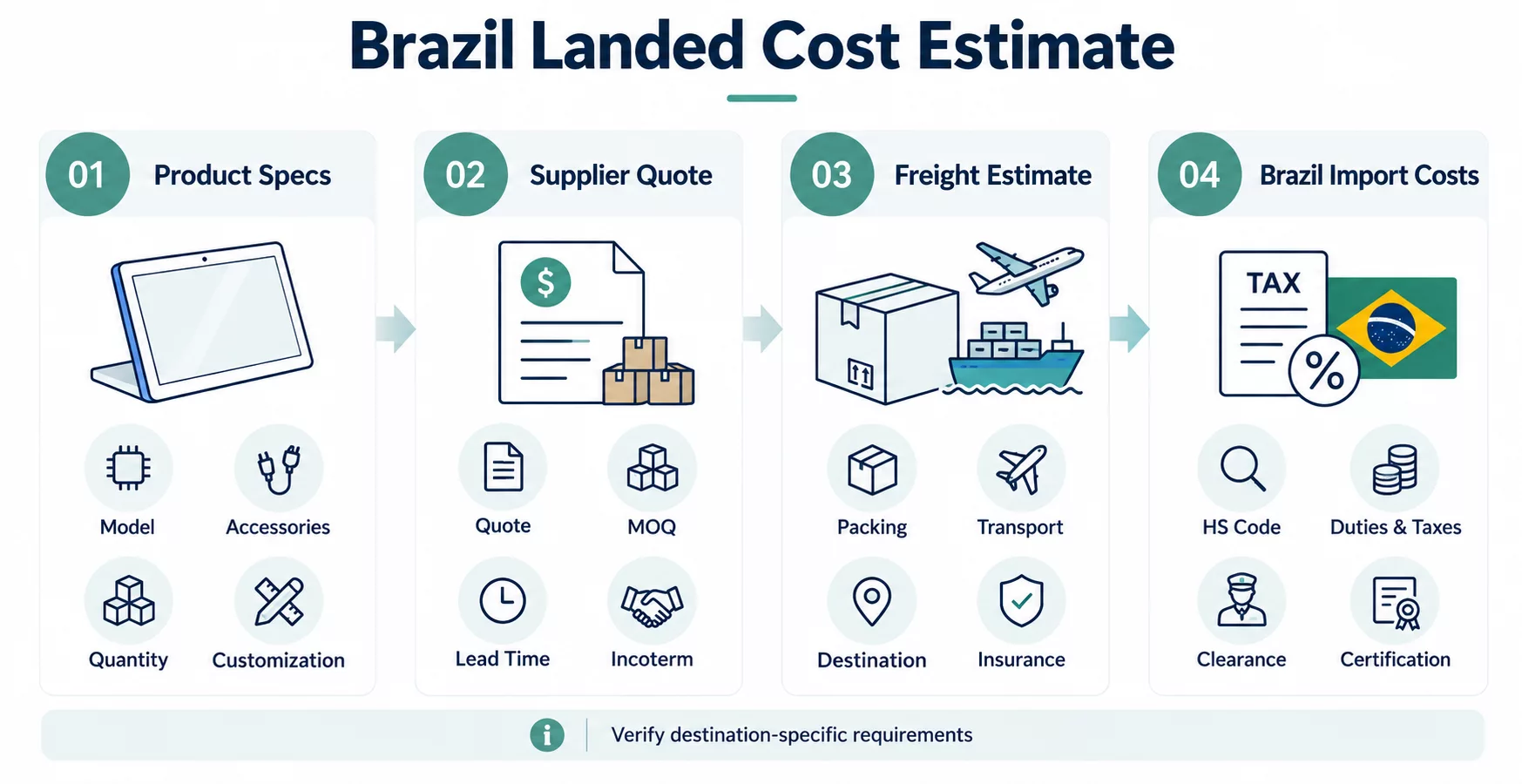
Step 4: Build the Brazil import-cost estimate.
The buyer can combine the confirmed product quotation and freight estimate with applicable import taxes, customs-clearance charges, and domestic delivery costs. The tariff classification, tax treatment, and administrative requirements must be checked against the specific product and import circumstances.
Brazil’s official government service provides a starting point for checking the tax and administrative treatment of imports: Simulate the tax and administrative treatment of imports. Product certification requirements should also be checked where relevant; Anatel provides information about product certification.
At this stage, we should not present a final landed cost without the confirmed configuration, order quantity, freight quotation, applicable classification, and import-cost inputs. The purpose of the process is to replace assumptions with verifiable figures before the buyer commits to an order.
3. How to Calculate Landed Cost per Unit for Electronics and Compare Order Options
Once the cost categories are clear, buyers can use a single calculation model to compare different suppliers, order quantities, and customization options. Understanding how to calculate landed cost per unit for electronics helps buyers identify the real cost differences between sample orders, bulk purchases, and competing supplier quotes.
Put Product Costs, Freight, and One-Time Fees into One Landed Cost Model
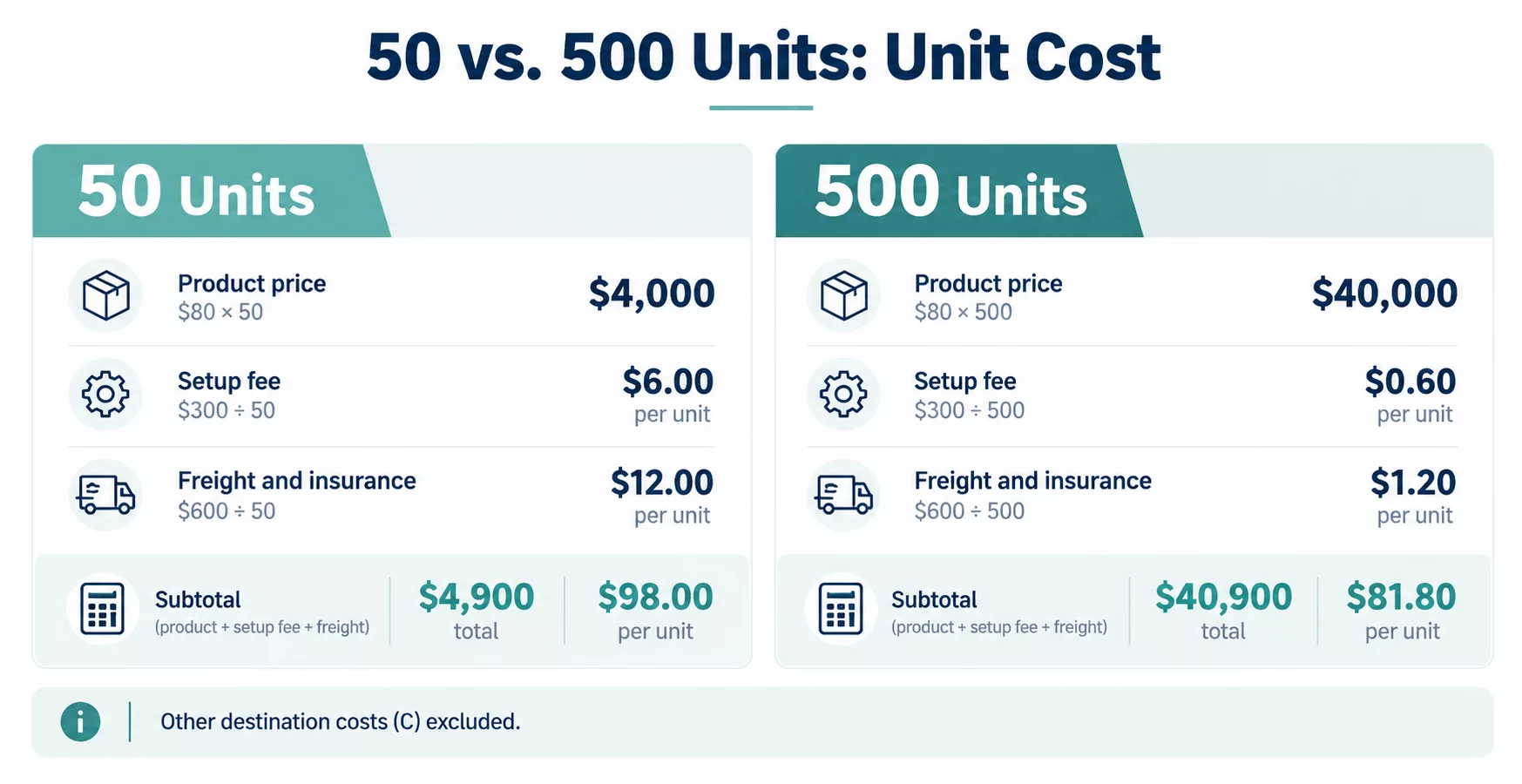
- Consider an illustrative procurement scenario—not an actual CnHopestar quotation—with the following assumptions:
- Product price: $80 per unit
- One-time customization setup fee: $300
- Freight and insurance: $600 for the shipment
- Other import, clearance, and delivery charges: represented by C
Quantity: either 50 units or 500 units
The estimated cost per unit before the other import and delivery charges is:
| Cost component | 50-unit order | 500-unit order |
| Product cost | $4,000 | $40,000 |
| One-time setup fee | $300 | $300 |
| Freight and insurance | $600 | $600 |
| Total before other charges | $4,900 | $40,900 |
| Cost per unit before other charges | $98.00 | $81.80 |
In this simplified example, the same $300 setup fee adds $6 per unit to a 50-unit order but only $0.60 per unit to a 500-unit order. The assumed freight charge is also spread across more units in the larger order.
- The final landed cost per unit would be:
- 50 units: ((4,900 + C₅₀) ÷ 50)
- 500 units: ((40,900 + C₅₀₀) ÷ 500)
Here, C₅₀ and C₅₀₀ represent the other applicable costs for each shipment. They may differ because freight, taxes, clearance, and delivery charges do not necessarily scale in direct proportion to quantity.
The lesson is not that a larger order is always cheaper. It is that buyers should compare the full cost at each realistic order quantity, including the working capital required and the risk of holding unsold inventory.
Use Chargeable Weight to Estimate Android Tablet Shipping Costs
Packaging can change the shipping cost even when the product itself is unchanged.
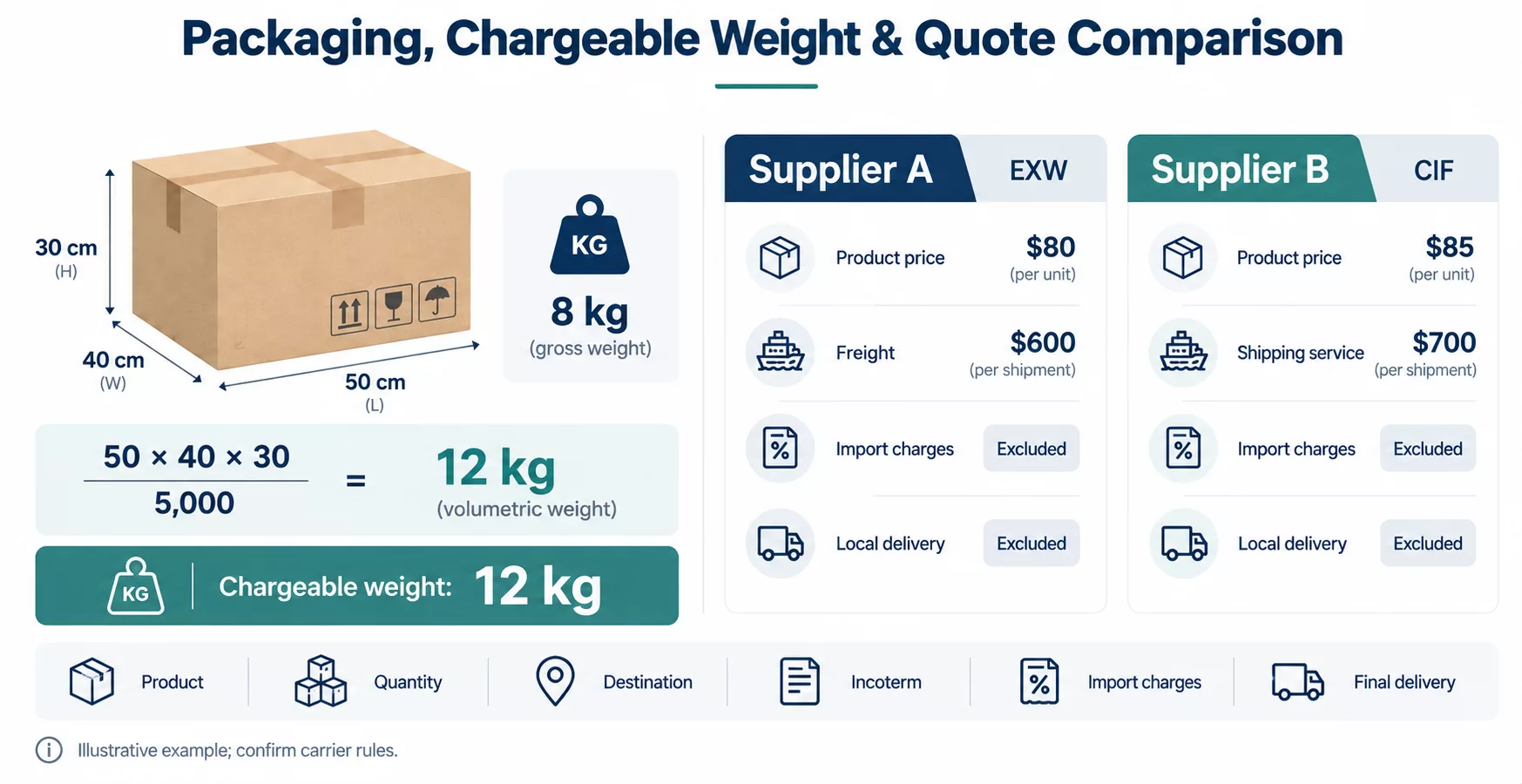
For example, assume a shipping carton measures 50 × 40 × 30 cm and has a gross weight of 8 kg. Using an illustrative volumetric divisor of 5,000:
Volumetric weight = 50 × 40 × 30 ÷ 5,000 = 12 kg
The volumetric weight is 12 kg, higher than the actual gross weight of 8 kg. If the carrier applies the stated divisor and charges the higher of gross and volumetric weight, the shipment would be charged at 12 kg for that carton.
The divisor, rounding rules, and chargeable-weight method vary by carrier and transport service. This example is for explaining the calculation, not a freight quote. Buyers should obtain the actual carton dimensions and gross weight from the supplier and confirm the applicable billing rules with their freight forwarder.
Normalize Supplier Quotes to Compare Total Import Costs
Suppose Supplier A offers a lower product price but quotes freight separately, while Supplier B offers a higher product price that includes a defined shipping service. Neither quote is automatically better.
- To compare them, calculate the same scenario for both suppliers:
- Match the product configuration, accessories, customization, and order quantity.
- Add any setup, tooling, or other one-time fees.
- Add freight and insurance using the same destination and comparable delivery scope.
- Add the relevant import, clearance, and local delivery costs.
Divide the total by the number of usable units received.
Also confirm the Incoterm and named place or port. A CIF price, for example, should not be treated as if it necessarily includes import duties, taxes, customs clearance, and final delivery.
The lower unit-price option can become more expensive if it requires costly customization, uses less efficient packaging, or excludes services that the buyer must purchase separately. Conversely, a higher initial quote may be the better option if it covers more of the required scope. Only a like-for-like calculation can establish which offer is more economical.
Separate Sample Order Costs from Production Order Costs
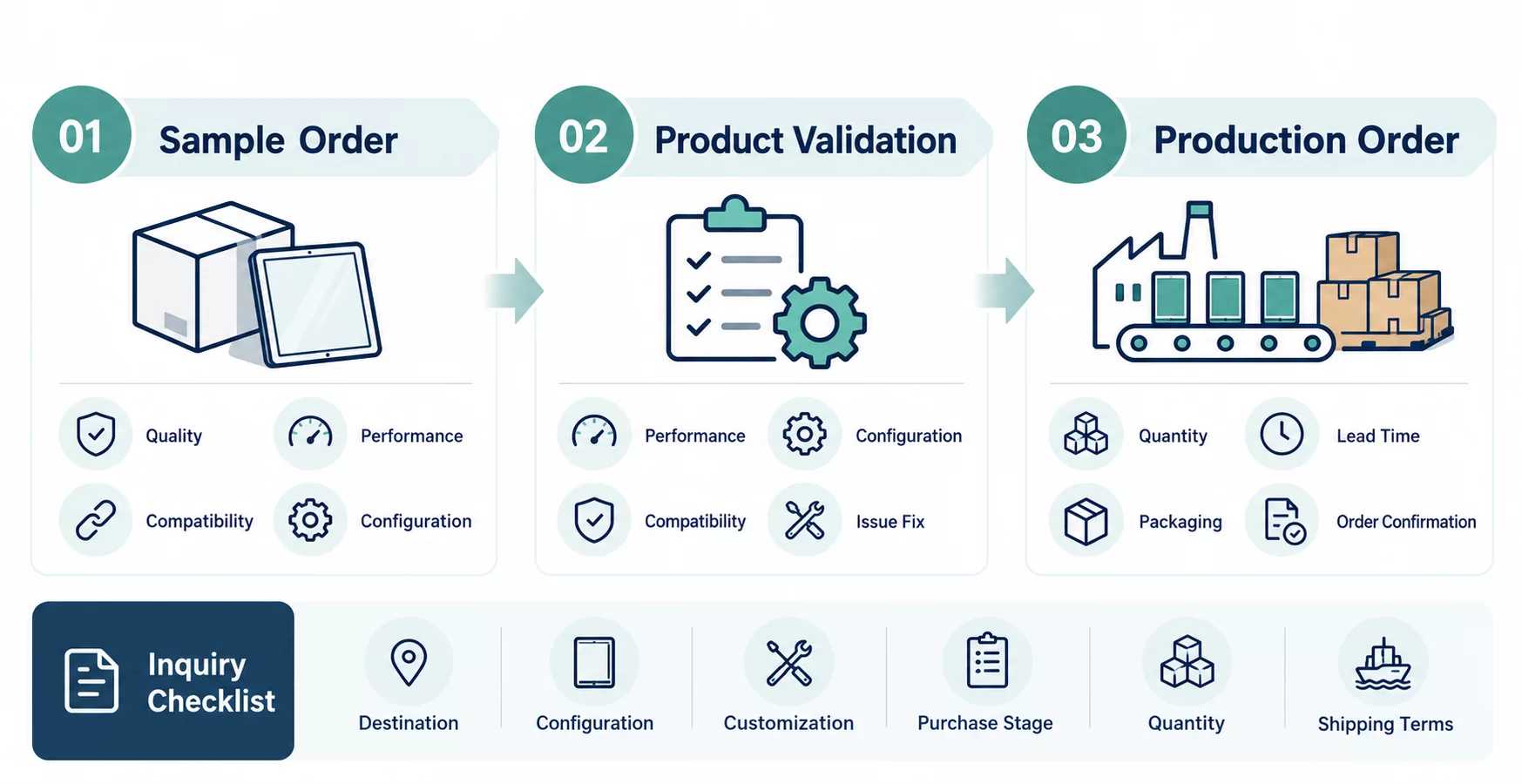
A sample order and a production order answer different questions. A sample helps validate the product, performance, compatibility, and customization before the buyer commits to a larger purchase. Its per-unit cost can be high because fixed costs and shipment charges are spread over very few units.
A production order may reduce the unit cost through larger quantities and more efficient packaging, but it also increases the buyer’s upfront commitment and inventory exposure. Sample pricing should therefore not be compared directly with bulk pricing without accounting for the different quantities, shipping arrangements, and one-time fees.
For a practical decision, prepare at least two estimates: one for the sample or pilot stage, and one for the intended production quantity. Compare their total cash outlay, estimated cost per usable unit, lead time, and unresolved import costs. This helps buyers decide whether to validate the product first or proceed to a larger order.
4. What We Need to Prepare an Android Tablet Import Cost Estimate
- At CnHopestar, we help buyers move from a general product inquiry to a quotation that is easier to evaluate against other offers. As an Android tablet OEM supplier, we can provide product pricing and configuration details, clarify MOQ and lead time, and share packaging information to support a more practical landed-cost estimate. To prepare the right information, we need the following details:
- Destination: country, city, and delivery address or intended port, if known.
- Product requirements: screen size, operating system, hardware configuration, accessories, and application.
- Customization: logo, housing, packaging, pre-installed software, or other OEM/ODM requirements.
- Purchase stage: sample, pilot order, or mass production.
- Order range: estimated quantity or expected order volume.
- Delivery preference: preferred Incoterm or shipping arrangement, if already decided.
With these details, we can confirm the relevant Android tablet configuration, provide a quotation for the requested quantity, clarify MOQ and estimated production lead time, and share available packaging dimensions and gross-weight information for logistics estimation. Where customization is required, we can also identify the applicable setup or customization charges in the quotation.
The buyer can then use these supplier-side figures to obtain a freight estimate and verify destination-specific import costs with the relevant customs broker or authorities. This creates a more consistent basis for comparing suppliers and evaluating the expected cost per unit.
Contact CnHopestar with your target Android tablet configuration, destination, and expected order quantity. We can help you clarify the product quote, MOQ, lead time, customization scope, and packaging information needed to plan your Android tablet import.
 Gaming Monitor OEM Buying Guide: 7 Questions First-Time Brands Should Ask